PRINT PLAYBOOK GUIDE - PRODUCTION GUIDES
Part of Series: Production Guides
Poster Printing Explained
 ND4C Print Experts
Quick Answer: How Does Poster Printing Work?
Poster printing produces larger printed graphics intended to communicate visually from farther away than most brochures, flyers, postcards, or other commercial print pieces.
The best way to produce a poster depends on its finished size, quantity, paper or material, color requirements, image quality, finishing, turnaround, and intended use. Most poster jobs fall within established catalog options, but specifications outside the available catalog may require a custom estimate.
30-Word Definition
Poster printing is the production of larger-format printed graphics designed for display, promotion, advertising, events, presentations, or décor, using a production method appropriate for the poster's size, quantity, stock, and use.
Key Takeaways
- Poster production should begin with the finished size, quantity, material, and intended use.
- Poster size can influence equipment selection, paper utilization, cost, finishing, shipping, and file preparation.
- Artwork resolution matters more as finished size increases. An image that works well on a smaller printed piece may not reproduce well when enlarged to poster dimensions.
- Very small poster runs may benefit from short-run pricing, but repeated end-customer demand can sometimes make a larger initial order more economical.
- Most jobs can be handled through established catalog products. Custom estimating is generally only necessary when the specifications fall outside the catalog.
- Stock should be selected according to how the poster will be displayed, handled, shipped, or mounted.
- File problems, incorrect specifications, timing, and incomplete order information can create avoidable production delays.
What Is Poster Printing?
Poster printing is the production of printed graphics designed primarily for visual display.
Unlike brochures, postcards, or business cards, posters are usually intended to communicate from a greater viewing distance and across a larger physical area.
Common poster applications include:
- Retail promotions
- Event advertising
- Educational displays
- Presentations
- Promotional campaigns
- Point-of-purchase displays
- Indoor signage
- Trade show graphics
- Temporary announcements
- Decorative graphics
The word poster describes the finished application rather than one specific printing technology.
A poster may be produced using different equipment depending on:
- Finished dimensions
- Quantity
- Paper or substrate
- Color requirements
- Production method
- Finishing
- Turnaround
- Intended environment
That makes poster printing a production decision rather than simply a product-size decision.
How Does Poster Printing Work?
Poster production usually follows the same basic workflow as other commercial print products, but size and viewing distance create additional considerations.
1. Determine the Poster's Purpose
Start by establishing where and how the poster will be used.
Ask:
- Will it be displayed indoors or outdoors?
- Is it temporary or intended for longer use?
- Will viewers stand close to it?
- Will it be mounted, framed, hung, taped, or inserted into a display?
- Does it need to ship individually?
- Will several posters be used together?
- Is it primarily informational, promotional, or decorative?
The application helps determine the appropriate size, stock, image quality, and finishing.
2. Confirm the Finished Size
Finished size is one of the most important poster specifications.
It can affect:
- Production method
- Available paper sizes
- Sheet utilization
- Waste
- Trimming
- Packaging
- Shipping
- Display method
- File preparation
A size that seems only slightly different may fit production equipment very differently.
For that reason, the exact finished dimensions should be established before the job is quoted or final artwork is prepared.
3. Confirm the Quantity
Quantity affects production economics.
A handful of posters may need a different pricing approach than hundreds or thousands of identical posters.
For very small poster orders, comparing digital short-run poster pricing may make sense. But resellers should also consider how the finished product will actually be sold.
If an end customer is likely to reorder the same poster repeatedly, purchasing a larger quantity initially and reselling it in smaller batches may produce better overall economics than placing a new short-run order each time.
This is especially useful for resellers managing repeat programs.
Direct Answer: Should a Reseller Always Order the Smallest Quantity Needed?
No. If the artwork is unlikely to change and the end customer will need the same poster repeatedly, a larger initial run may create a lower overall production cost and allow the reseller to fulfill future orders from inventory.
The tradeoff is inventory risk. If the design, message, dates, pricing, branding, or other content may change, a smaller run may still be the safer business decision.
Direct Answer: Does Poster Quantity Affect Unit Cost?
Yes. Production usually includes costs that are not purely proportional to the number of pieces produced. As quantity increases, setup and other fixed production costs may be distributed across more posters, changing the unit economics.
For very small quantities, customers may want to compare short-run options. For repeat programs, however, the lowest immediate order quantity is not always the best long-term decision.
Evaluate: current quantity + expected reorders + likelihood of artwork changes + inventory risk rather than unit cost alone.
4. Select the Poster Stock
The poster's intended use should guide material selection.
Relevant questions include:
- Does it need to feel substantial?
- Will it be framed?
- Will it hang unsupported?
- Will it be mounted to another surface?
- Will it need to roll for shipping?
- How long will it be displayed?
- Does it require a particular surface appearance?
Paper characteristics can influence appearance, rigidity, color reproduction, handling, durability, weight, shipping, and cost.
A heavier stock is not automatically better.
Most professional print buyers already have a good understanding of paper, but when there is uncertainty, a physical sample is more useful than trying to judge stock from a screen.
ND4C Production Note
ND4C customers can request a sample pack to see and feel available stocks and finishes before making the production decision. That can be particularly helpful when a reseller needs to recommend an option to an end customer or compare several similar materials.
5. Prepare the Artwork
Poster artwork should be designed around the actual finished product.
Important file considerations include:
- Correct finished dimensions
- Bleed
- Safe areas
- Image resolution
- Color mode
- Fonts
- Linked graphics
- Line thickness
- Image quality
- Viewing distance
Large Artwork Creates a Specific Production Risk
One of the more important poster-specific file problems is insufficient image resolution.
Artwork that reproduces acceptably on a postcard, flyer, or brochure may not contain enough image information to print well when enlarged to poster dimensions. Enlarging an image does not create new detail.
Before submitting a poster file, evaluate the artwork at the actual finished scale rather than assuming that because the file looks sharp on a monitor it will reproduce sharply at poster size.
The goal is not to create the largest possible file. The goal is to provide enough usable image information for the final printed size and intended viewing distance.
For complete artwork-preparation requirements, see the File Setup Guide.
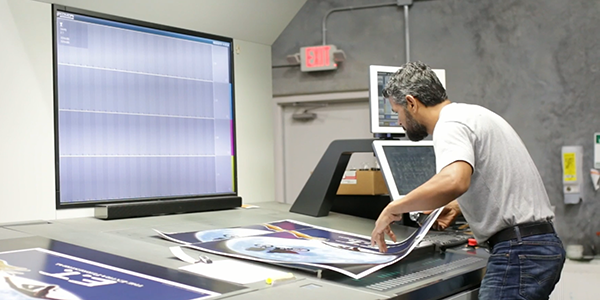
6. Print the Posters
Once the job specifications and artwork are approved, the posters are produced using the printing method appropriate for the job.
Production selection can be influenced by finished size, quantity, stock, color, image coverage, turnaround, equipment capabilities, required consistency, and finishing.
Most poster jobs fit within ND4C's established catalog offerings.
When Should a Reseller Request a Custom Estimate?
A custom estimate is generally only needed when the requested job falls outside the existing catalog. Because the catalog covers a broad range of standard production needs, this represents a relatively small portion of normal poster orders.
Start by checking the ND4C product catalog. If the required size, stock, quantity, finishing, or other specification is already available, the standard product is generally the appropriate starting point.
7. Trim and Finish the Posters
After printing, posters are typically trimmed to their final dimensions.
Depending on the application and available product specifications, additional finishing may also be required.
Examples can include cutting, mounting, laminating, scoring, folding, special packaging, or preparing pieces for display.
Finishing should be identified during quoting because it can affect both cost and turnaround.
If a required option does not exist within the standard catalog, that is the point at which a custom estimate may need to be investigated.
8. Package and Ship the Posters
Poster size and stock affect how the finished product can be packaged.
Larger pieces may require more protection and can create different shipping considerations than smaller commercial print products.
Packaging becomes increasingly important as finished dimensions increase.
A poster that is inexpensive to print but difficult to pack or ship may not be the most economical finished solution.
Shipping requirements should therefore be considered during quoting rather than after the job has already been produced.
What Factors Matter Most in Poster Printing?
Poster Size
Finished size can influence nearly every stage of production. It affects equipment, paper utilization, waste, trimming, packaging, shipping, display, and file dimensions.
It also directly affects artwork requirements. The larger the finished poster becomes, the more important it is to verify that raster images contain enough information to reproduce cleanly at the required scale.
Size should therefore be treated as both a production specification and a file-quality specification.
Quantity
Quantity affects how production costs are distributed.
For a one-time, very small job, short-run pricing may make sense. For a poster that an end customer will reorder repeatedly, however, resellers should compare the economics of producing a larger quantity once and fulfilling future customer orders from inventory.
For Repeat Poster Programs, Compare More Than Unit Cost
Consider expected reorder frequency, artwork lifespan, storage, cash flow, inventory risk, unit cost, and reseller margin. This is more useful than simply asking which quantity has the cheapest unit price.
Paper or Stock
Stock affects appearance, handling, weight, rigidity, and cost.
Poster stock should fit both the visual objective and the physical use of the piece.
If a reseller or end customer is uncertain about the difference between available stocks or finishes, evaluating physical samples before ordering can prevent unnecessary guesswork.
Image Quality
Posters are image-driven products.
Low-resolution source images may become visibly soft or pixelated when enlarged. This is one of the file concerns that deserves extra attention specifically because posters are physically larger than many standard commercial print products.
At the same time, unnecessarily oversized files can create workflow problems without producing a visible improvement.
Image quality should be evaluated according to:
source quality + final size + viewing distance
Viewing Distance
A poster viewed from across a room has different design requirements than a print examined from several inches away.
Viewing distance affects image-resolution requirements, typography, type size, contrast, line thickness, visual hierarchy, and amount of detail.
This is both a file-preparation and design consideration.
Color
Poster graphics often depend heavily on photography, illustration, branding, or strong visual contrast.
Color expectations should be established before production.
Printed color can be affected by the printing process, paper, ink or toner, image preparation, color values, and source artwork.
A color shown on a monitor should not automatically be assumed to reproduce identically in print.
Finishing
Finishing requirements can materially change the job.
Even a simple poster may require more than printing if it must be mounted, packaged a particular way, or prepared for a specific display system.
If the desired finishing is not part of the standard catalog offering, verify whether the job needs to move into custom estimating.
Turnaround
Poster jobs are frequently tied to events, promotions, openings, campaigns, or other fixed dates.
Avoidable delays can come from file problems, incorrect specifications, missing information, stock or production questions, late approvals, ordering too close to the required date, missing production cutoffs, and shipping time.
Turnaround Reminder
Review the production checklist before placing the order. A few minutes confirming the specifications before submission can prevent delays that become much harder to solve once a deadline is close.
For current production timing and cutoff guidance, review ND4C's turnaround information.
How Does Poster Printing Affect Cost?
Poster cost is driven by a combination of variables rather than a single price-per-square-inch calculation.
Simple Cost Framework
setup + material + printing + finishing + waste + packaging + shipping
Setup Cost
Jobs may involve file review, preparation, equipment setup, material loading, proofing, or other production steps before the full run begins.
At very low quantities, these costs are spread across fewer pieces. This is one reason very small runs can carry a higher unit cost.
Material Cost
Larger posters consume more material, but material cost is also influenced by how efficiently the finished dimensions fit the production sheet.
Two posters with similar total area can have different production economics if one creates substantially more sheet waste.
Printing Cost
Printing cost can be influenced by production method, quantity, poster size, stock, color requirements, image coverage, and equipment efficiency.
Quantity and Repeat Orders
For resellers, immediate unit price should not always be the only calculation.
One-time promotion: The artwork will become obsolete after an event or campaign. A small run may reduce waste and inventory risk.
Repeat end-customer program: The customer orders the same poster several times throughout the year. A larger initial production run may allow the reseller to buy at more favorable economics and fulfill smaller customer orders from inventory.
The second approach can improve margin, but only if the artwork is stable enough that the remaining inventory is likely to be sold.
Finishing Cost
Additional cutting, mounting, lamination, packaging, or other finishing adds production steps. These costs should be considered before the job is quoted.
Waste
Material that cannot become finished product still contributes to production cost.
Waste may result from sheet dimensions, trim requirements, bleed, setup, production spoilage, or inefficient finished sizes.
Better sheet utilization can sometimes improve the economics of a poster job.
Shipping Cost
Poster dimensions and stock can materially affect packaging and shipping.
Shipping should therefore be considered part of the job specification rather than something evaluated after printing.
Direct Answer: Are Bigger Posters Always Much More Expensive?
Not necessarily. A larger poster uses more material, but the actual change in cost depends on how the dimensions interact with the production sheet, quantity, printing method, finishing, waste, packaging, and shipping.
A relatively small change in finished dimensions can sometimes have a larger-than-expected cost effect if it changes sheet utilization or production requirements.
For a deeper explanation, see How Paper Size Affects Print Cost.
What Are the Advantages of Printed Posters?
Strong Visual Impact
Posters provide significantly more visual area than most standard commercial print products. This makes them useful for communication that needs to be noticed at a distance.
Flexible Quantities
Poster production can support campaigns requiring only a few pieces as well as jobs requiring larger quantities.
For resellers serving repeat customers, this also creates flexibility between purchasing a small immediate run and holding inventory from a larger run for future fulfillment.
Broad Range of Applications
Posters work well for events, retail, promotions, education, displays, presentations, and advertising.
Simple Finished Format
Many posters require only printing and trimming, making them relatively straightforward compared with products involving folding, binding, or complex assembly.
Easy Campaign Coordination
Poster artwork can often be coordinated with related postcards, flyers, brochures, or other promotional pieces.
What Are the Limitations of Poster Printing?
Large Artwork Demands Better Source Files
Poster size magnifies weaknesses in raster artwork.
A source image that is adequate for a smaller print product may not reproduce cleanly when enlarged substantially. This should be checked before the order reaches production.
Size Can Change Production Requirements
As a poster becomes larger, production requirements may change.
If the required specification falls outside the catalog, the job may need a custom estimate.
Shipping Can Become More Complicated
Large pieces require more protection and physical space.
Paper Posters Have Application Limits
A paper poster may not be appropriate when the job actually requires exterior durability, rigid signage, banner material, adhesive graphics, or structural display components.
In those situations, the customer may need a different product category or production provider.
Poster Printing vs. Flyers and Brochures
Posters, flyers, and brochures can carry similar promotional content, but their production and design requirements differ.
| Factor | Posters | Flyers / Brochures |
|---|---|---|
| Primary purpose | Display and distance viewing | Handheld communication |
| Viewing distance | Usually farther | Usually close |
| Typical information density | Lower | Higher |
| Image scale | Larger | Smaller |
| Image-resolution risk | More noticeable when enlarged | Usually less enlargement |
| Type size | Generally larger | Generally smaller |
| Production size | Larger | Standard commercial sizes |
| Finishing | Usually simple | May include folds or other finishing |
| Shipping | Size can be significant | Usually easier to carton |
| Best use | Visual impact | Detailed information |
A poster should not simply be designed as an oversized flyer. The larger viewing distance changes how information should be prioritized and presented.
Poster Printing vs. Large Format Printing
Poster printing and large format printing overlap, but they are not synonymous.
Poster printing describes a specific printed product.
Large format printing describes a broader production category that can include large signs, banners, display graphics, window graphics, wall graphics, and other oversized applications.
Some posters can be produced through standard commercial printing workflows. Other applications may require dedicated large-format production that is outside a standard poster offering.
Practical Rule
Start with the actual product specification, not the label.
- Finished size
- Quantity
- Stock or substrate
- Intended use
- Finishing
- Turnaround
Then verify whether those specifications exist within the available catalog. If they do not, investigate custom production or another appropriate provider.
When Does a Poster Job Require a Custom Estimate?
At ND4C, a poster job generally moves to custom estimating only when the requested specifications fall outside the existing catalog.
The catalog is extensive enough to cover the overwhelming majority of normal poster jobs.
That means the first step should not be requesting a custom quote.
- Confirm the required size.
- Confirm quantity.
- Confirm stock.
- Confirm available finishing.
- Check the corresponding catalog product.
- Request a custom estimate only if the required specification is unavailable.
This keeps quoting simpler and avoids treating routine production as custom work.
How Should Poster Size Be Chosen?
Poster dimensions should be selected according to the intended display environment rather than simply choosing the largest available size.
Consider:
- Available wall or display space
- Viewing distance
- Amount of content
- Required type size
- Source-image quality
- Production efficiency
- Frame or display dimensions
- Packaging
- Shipping
- Budget
A slightly smaller poster can sometimes provide nearly the same communication value while improving production efficiency or simplifying shipping.
Just as importantly, the chosen size must be supported by the source artwork.
Increasing the poster dimensions without considering image resolution can turn an otherwise well-designed file into a poor-quality finished piece.
For the deeper cost relationship between dimensions and production, see How Paper Size Affects Print Cost.
Common Poster Printing Mistakes
Mistake: Using Artwork That Cannot Support the Final Size
Why it matters: This is particularly important with posters because enlargement can expose weaknesses that are not obvious at smaller sizes. Low-resolution raster artwork may appear acceptable on screen or in a smaller layout but reproduce poorly when printed at poster scale.
Better approach: Evaluate raster images at the intended output size before submitting the job. Do not assume enlarging the file dimensions improves the underlying artwork.
Mistake: Creating Artwork at the Wrong Finished Size
Why it matters: Incorrect dimensions can affect bleed, cropping, image scaling, type placement, and production.
Better approach: Set the artwork to the correct finished dimensions or an approved proportional scale from the beginning.
Mistake: Forgetting Bleed
Why it matters: Artwork intended to run to the edge of the finished poster needs additional image area beyond the trim.
Better approach: Follow the production provider's bleed requirements when preparing the file.
Mistake: Putting Important Content Too Close to the Trim
Why it matters: Normal finishing variation can make text or important graphics appear uncomfortably close to the finished edge.
Better approach: Keep critical elements safely inside the trim area.
Mistake: Designing a Poster Like a Brochure
Why it matters: Too much small text makes a poster difficult to understand at normal viewing distance.
Better approach: Use strong visual hierarchy, concise messaging, readable typography, and fewer competing elements.
Mistake: Ordering Only for Today's Need Without Considering Reorders
Why it matters: A very small run may make sense initially, but repeated small orders of identical artwork can sometimes cost more over time.
Better approach: If the end customer is likely to reorder the same poster, compare a larger initial quantity against repeated short runs. Balance the possible unit-cost savings against the risk of holding outdated inventory.
Mistake: Guessing at Stock When Appearance Matters
Why it matters: Stock descriptions and on-screen images cannot fully communicate thickness, texture, finish, or feel.
Better approach: If the reseller or end customer is uncertain, request physical samples before making the final selection.
Mistake: Waiting Until Production to Think About Display
Why it matters: A poster intended for a frame, stand, window, wall, or mounting system may need specific finished dimensions or materials.
Better approach: Confirm the display method before choosing the poster specification.
Poster Production Checklist
- ☐ Exact finished width and height confirmed
- ☐ Quantity confirmed
- ☐ One-time job or likely reorder pattern identified
- ☐ Short-run or larger-quantity pricing comparison considered
- ☐ Intended application confirmed
- ☐ Indoor or outdoor use confirmed
- ☐ Expected viewing distance considered
- ☐ Display or mounting method confirmed
- ☐ Paper or stock selected
- ☐ Physical sample reviewed if stock or finish is uncertain
- ☐ Color requirements understood
- ☐ Artwork uses correct dimensions
- ☐ Bleed included where required
- ☐ Important content is safely inside the trim
- ☐ Raster images contain sufficient resolution for final poster size
- ☐ Fonts and linked assets are properly supplied
- ☐ Finishing requirements identified
- ☐ Requested specifications are available in the standard catalog
- ☐ Custom estimate requested if the job falls outside catalog specifications
- ☐ Turnaround verified
- ☐ Production cutoff considered where applicable
- ☐ Packaging needs considered
- ☐ Shipping time considered
Checking these items before placing the order can prevent many of the specification, file, and scheduling issues that create avoidable delays.
Direct Answers About Poster Printing
What production method is best for posters?
There is no single best production method for every poster. Finished size, quantity, stock, color requirements, turnaround, and available catalog specifications determine the appropriate approach.
When does a poster require a custom estimate?
Generally, when the requested specifications fall outside the available product catalog. Most routine poster jobs can be handled through established catalog options.
Should a reseller buy a larger poster quantity than the customer immediately needs?
Sometimes. If the same artwork will be reordered repeatedly, a larger initial run may create better overall economics and allow the reseller to supply smaller quantities from inventory. If the artwork may change, a smaller run can reduce inventory risk.
What is one of the biggest file risks with posters?
Insufficient artwork resolution. Because posters are large, source images that work well for smaller printed pieces may not contain enough detail to reproduce well at poster scale.
How can poster-production delays be reduced?
Confirm the full specification before ordering. Check dimensions, stock, quantity, artwork, resolution, bleed, finishing, turnaround, and required delivery date against the production checklist before submitting the job.
How should a reseller choose poster stock?
Start with how the poster will be displayed and handled. When appearance or finish is difficult to judge remotely, review a physical sample pack before recommending the stock to the end customer.
Common Questions About Poster Printing
What size should a poster be?
The best size depends on viewing distance, available display space, amount of content, image quality, production efficiency, budget, and any frame or display-system requirements. There is no universally correct poster size.
Does a poster need bleed?
If artwork extends to the finished edge, bleed is generally required so the piece can be trimmed without leaving unintended unprinted edges. Follow the specific file requirements for the product being ordered.
How much resolution does a poster need?
Resolution should be evaluated according to the poster's final dimensions and expected viewing distance. Because posters are enlarged substantially, verify that source raster images contain enough usable information for the required final size.
Can I enlarge a photo for a poster?
Possibly. The result depends on the original image dimensions, image quality, amount of enlargement, final poster size, and viewing distance. A low-quality source image cannot be made truly detailed simply by increasing its file dimensions.
Are posters better printed digitally or offset?
It depends on the job. Digital production can be advantageous for shorter runs and flexible quantities, while other production methods may become more attractive as specifications and quantities change. See Digital Printing Explained and Offset Printing Explained for the production-method fundamentals.
When should short-run poster pricing be considered?
Short-run pricing is most relevant for very small jobs. If the same poster will be reordered repeatedly, compare that approach against producing a larger quantity initially and reselling the inventory in smaller batches.
Does paper thickness matter for posters?
Yes. Thickness and rigidity can affect appearance, handling, display, packaging, weight, and shipping. If the difference between stocks or finishes is difficult to evaluate, physical samples can make the decision much easier.
Why does poster size affect pricing?
Poster dimensions influence more than the amount of paper used. They can affect sheet utilization, waste, equipment compatibility, finishing, packaging, and shipping. See How Paper Size Affects Print Cost for the deeper production economics.
Is the cheapest poster quantity always the best quantity?
No. Resellers should consider both immediate cost and expected future demand. A larger quantity may lower overall production cost when identical posters will be reordered, while a smaller quantity can reduce the risk of being left with obsolete inventory.
What poster specifications normally require custom estimating?
Custom estimating is generally appropriate when the requested job falls outside the established catalog. Start with the standard catalog because it covers most normal poster-production needs.
Can multiple poster designs be produced in one order?
This depends on how the job is quoted and produced. If multiple versions are needed, provide the number of designs and quantity required for each version when requesting pricing.
Should posters be designed differently from flyers?
Yes. Posters are typically viewed from farther away, so they benefit from larger type, fewer competing messages, stronger visual hierarchy, and simpler communication.
How to Decide Whether Poster Printing Fits the Job
1. Is the finished product primarily a printed display graphic?
If yes, poster production may be appropriate.
2. What are the exact finished dimensions?
Confirm them before evaluating pricing or artwork.
3. How many are needed now?
Quantity helps determine the immediate production economics.
4. Will the same poster be reordered?
If yes, compare repeated short runs against producing a larger quantity and holding inventory.
5. Is the artwork suitable for the final size?
Verify raster-image quality before ordering. Large poster dimensions can expose resolution problems that are easy to miss in smaller artwork.
6. What stock should be used?
Choose according to the application rather than weight alone. Request physical samples when the customer needs help comparing stocks or finishes.
7. Are the required specifications available in the catalog?
If yes, use the appropriate standard product. If not, investigate a custom estimate.
8. Have all production details been checked?
Review the checklist before submitting the order to reduce avoidable delays.
Reseller Production Advice
Quote More Than One Quantity When Appropriate
If an end customer may reorder the same design, comparing several quantities can help the reseller see whether holding inventory could improve margin.
Protect Against Obsolete Inventory
Do not chase a lower unit cost when the artwork contains dates, pricing, temporary offers, changing locations, or information likely to become outdated.
Check Image Quality Before Promising the Job
Large output exposes image-quality problems. Confirm artwork suitability before committing to an end customer, especially when the customer supplies photography or raster graphics.
Use Physical Stock Samples When the Decision Is Subjective
A reseller can explain paper specifications, but customers often make better decisions when they can actually see and feel the options.
Check the Catalog Before Requesting Custom Work
Most standard poster jobs can be handled through existing products. Custom estimating should be reserved for specifications that genuinely fall outside those offerings.
Related Production Guides
Digital Printing Explained
Read this guide to understand how digital commercial printing works and why it can be effective for many short-run and flexible-quantity print jobs.
Offset Printing Explained
Use this guide when comparing production economics for larger quantities or jobs where another commercial print process may be appropriate.
How to Choose a Printing Method
Read this when poster size, quantity, stock, turnaround, or another variable makes the best production method unclear.
How Paper Size Affects Print Cost
Use this guide to understand why finished dimensions, sheet utilization, and waste can materially affect pricing.
Short Run Printing Explained
Read this when the customer needs a small quantity of posters or when comparing a small immediate run against producing inventory for repeat orders.
File Setup Guide
Review this guide before submitting artwork to verify finished size, bleed, safe areas, images, fonts, and other production-file requirements.
Related Products and Applications
Poster printing commonly supports:
- Event promotions
- Retail displays
- Store promotions
- Educational graphics
- Presentation materials
- Point-of-purchase displays
- Indoor announcements
- Promotional campaigns
- Trade show displays
- Decorative graphics
Poster artwork may also coordinate with related print pieces such as flyers, brochures, postcards, rack cards, booklets, and other campaign materials.
For production options, compare ND4C's standard posters and digital short-run posters.
Final Next Step
Confirm the finished size, quantity, expected reorder pattern, stock, artwork resolution, turnaround, and catalog availability before placing the order.
For very small jobs, compare short-run options. For repeat programs, compare the economics of a larger production run against repeated smaller orders.
ND4C is a wholesale trade printer with more than two decades of industry experience. Our Print Playbook guides draw on firsthand expertise across prepress, production, customer support, design, and print technology to help retail printers and print resellers make better production decisions.